Contact Us
STATEN ISLAND FIBERAMA

Mooring systems work quietly until a line loads hard, a vessel shifts, or weather turns rough. For buyers comparing the top types of Foam-Filled Mooring Buoy in 2026, the right choice depends on more than buoy size. Service location, line arrangement, water depth, abrasion exposure, and inspection access all matter. A compact pickup buoy and a larger mooring buoy may look similar from shore, yet perform very different jobs.
UNCTAD’s Review of Maritime Transport 2024 reports that global seaborne trade reached about 12.3 billion tonnes in 2023, growing 2.4% from the previous year. That figure describes shipping activity, not buoy sales; it does, however, underline the importance of dependable port and offshore infrastructure. Conditions vary. This guide compares common buoy types by application, construction, flotation, visibility, and maintenance needs. Buyers should also check manufacturer data for buoyancy, safe working loads, hardware compatibility, and material resistance. Those figures need to match the project—not just a catalogue headline. Foam-filled construction can help maintain flotation after shell damage, but it does not make a buoy indestructible. No buoy is perfect. Actual performance depends on design, installation, loading, and upkeep. The sections ahead offer a practical starting point for comparing options, while leaving room for site-specific engineering review. Small details matter. A shackle that fits poorly or a coating unsuited to local exposure can shorten service life.
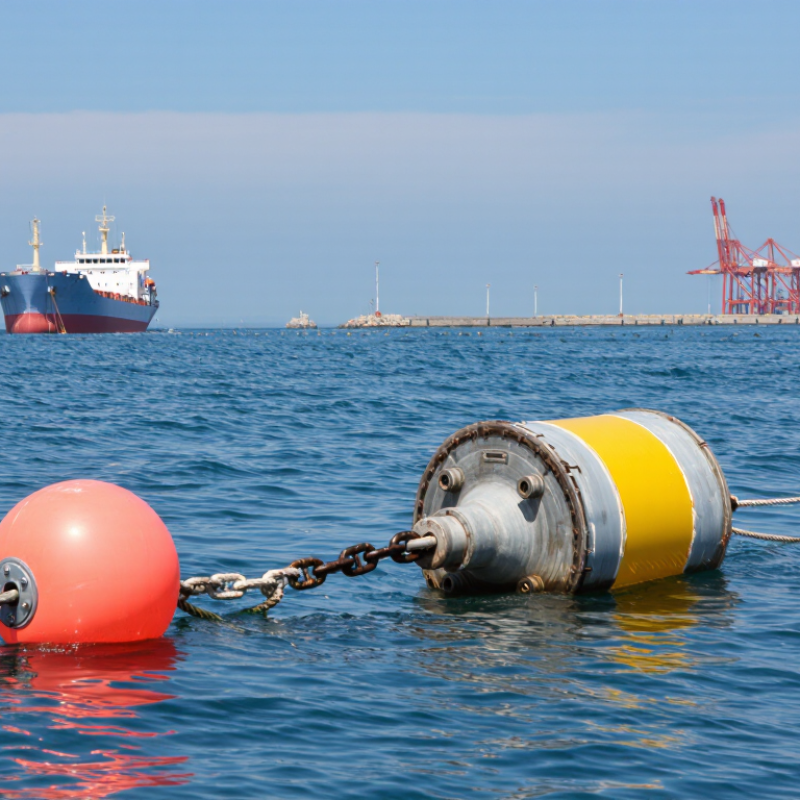
Foam-filled Mooring Buoys use a sealed outer shell and a buoyant foam core. The shell resists abrasion and impact; the core helps the buoy stay afloat if the shell is damaged. A vessel’s mooring line connects to a lifting point, while the buoy’s lower connection transfers load to the anchor chain and seabed.Simple in principle. But buoy size alone does not determine safe capacity.
The IOC/UNESCO TEOS-10 manual gives seawater density values that vary with temperature and salinity; about 1,025 kg/m³ is a useful planning estimate. At that density, one cubic metre of displaced water provides roughly 10.1 kN of gross buoyancy before subtracting the buoy’s weight. That is not its safe working load. Wave action, current, line angle, reserve buoyancy, and connection strength all matter. PIANC’s guidance on marine terminal systems also treats mooring loads as a system-design issue, rather than a buoy-only rating. One detail is easy to miss: damaged foam may still lose performance through water absorption.
Tips: Check freeboard, shell wear, lifting points, and chain fittings during inspections. Ask for documented buoyancy and load-test data; a clean surface can hide internal damage. Don’t guess.
A foam-filled mooring buoy performs well only when its materials, shape, and fittings suit the site. Closed-cell foam helps limit water uptake if the outer skin is punctured, but it does not make the buoy indestructible. A tough polymer shell can resist impact and sunlight; its thickness and formulation should match expected abrasion and exposure. Small details matter.
Buoy size and shape affect freeboard, stability, and how loads move through the body. A buoy riding too low may be difficult to identify and can take more wave impact. Check the stated buoyancy against the actual mooring load, including a practical reserve. Do not judge by diameter alone. A broader profile may add stability, yet create more drag in strong currents.
Inspect the attachment point, reinforcement, and any seams or molded transitions. These areas concentrate force, especially when a line pulls at an angle. Corrosion-resistant hardware and secure load paths matter as much as foam volume. In service, look for deep cuts, loosened fittings, deformation, and fading or cracking of the shell. Even a careful inspection can miss internal damage, so replacement decisions should consider age, site conditions, and the manufacturer’s documented limits. Thicker is not always better; added mass or stiffness can complicate handling without improving service life.
Foam-filled mooring buoys are commonly grouped by duty: pick-up buoys, permanent mooring buoys, and offshore single-point mooring buoys. Pick-up models are compact and easy to handle, with a lifting eye or pick-up line for retrieving a mooring. Permanent units are larger, often cylindrical or spherical, and provide a visible surface connection to an anchor system. Single-point mooring buoys are engineered for higher loads and may include reinforced steel structures and dedicated chain connections. Shape matters. A broad, low-profile buoy can sit more steadily, while a taller design may be easier to spot in choppy water.
Construction creates another useful distinction. Rotationally molded polyethylene shells with closed-cell foam cores resist corrosion and tolerate small impacts; steel shells with foam filling suit heavier-duty installations but need coating and inspection. Buyers should compare working load, reserve buoyancy, hardware, and exposure conditions, not just outer dimensions. DNV-RP-C205 uses a seawater density of 1,025 kg/m³ for environmental load calculations; that figure helps estimate gross displacement, but the buoy’s own mass and attached hardware reduce usable buoyancy. A calculation is essential.
For scale, one cubic meter of fully immersed volume displaces about 1.025 tonnes of seawater before deductions. In practice, waves, fouling, and uneven loading alter performance. The neat catalog label is not enough. Check the manufacturer’s load documentation and inspect welds, lifting points, and foam condition; hidden damage can be easy to miss.
Foam-filled mooring buoys are available in several shapes, and each suits a different working setup. Compact spherical models can serve as pickup or marker buoys in sheltered water. Larger cylindrical designs often provide more reserve buoyancy for heavier mooring lines. Their broad profile can also make them easier to spot from a working boat. For exposed sites, select a buoy rated for the expected loads and wave conditions, not appearance alone. Foam helps retain buoyancy if the outer shell is damaged, but it does not make a buoy indestructible.
Tips: Check the buoy’s rated buoyancy, attachment points, and freeboard against the full mooring load. Inspect the line connection for chafe. A mismatch here can shorten service life.
Application details matter. A pickup buoy needs to remain visible and manageable during retrieval; an offshore mooring buoy must handle changing line angles and repeated movement. In shallow water, consider whether the buoy could contact the seabed at low tide. That detail is easy to miss. Also account for sunlight, abrasion, and routine inspection access. Buyers sometimes focus too heavily on diameter, yet buoyancy, hardware strength, and maintenance conditions work together. There is no perfect shape for every site. A conservative choice may be heavier or costlier than needed, but undersizing can create a more serious problem.
How do buoy types suit different mooring applications? This indicative guide compares typical suitability on a 1–5 scale; scores are qualitative, not measured performance or a universal standard. Choose a buoy based on design loads, required reserve buoyancy, water conditions, and applicable standards.
2026 Top Types of Foam Filled Mooring Buoys for Buyers?
What Should Buyers Compare When Selecting a Buoy in 2026?
Buyers may encounter cylindrical, spherical, and pickup-style foam-filled mooring buoys. Shape affects visibility, handling, and how a buoy sits under changing line loads. Cylindrical models can suit inline support, while compact pickup buoys are easier to handle during retrieval. Check the intended mooring arrangement, not just the product photo.
Compare rated buoyancy with the buoy’s actual load, including chain, fittings, and expected water conditions. Ask what foam density and outer-skin construction are specified. A thick shell can resist routine abrasion, but it cannot prevent damage from every sharp edge or impact. Inspect attachment points, lifting eyes, and seams; these details often reveal more than color or shape. Request clear dimensions and maintenance guidance, too. Some specifications still leave questions.
Tips: Match the buoy to the line diameter and operating depth. Check it after installation for cuts, water ingress, or loose hardware. If the supplier cannot explain the load rating clearly, pause and verify it. Real-world wear can differ from a tidy specification sheet, and buyers should allow for that uncertainty.
| Comparison item | Typical design or data | Best suited to | What buyers should compare |
|---|---|---|---|
| Common foam-filled buoy configurations | |||
| Cylindrical mooring buoy | Upright or near-upright body, commonly with a central or through-body attachment arrangement. Dimensions and reserve buoyancy vary by design. | General-purpose moorings where a visible, accessible buoy body is needed. | Body diameter and height, attachment layout, freeboard under load, and whether the buoy can accommodate the specified mooring hardware. |
| Spherical or elliptical buoy | Rounded body profile with a broad range of sizes and attachment configurations. Rounded shapes can present less exposed flat surface than box-like forms. | General mooring applications where a compact rounded profile is appropriate. | Actual net buoyancy, loaded freeboard, eye or chain-attachment strength, and clearance from vessels and nearby structures. |
| High-freeboard buoy | Designed with greater visible height above the water for its intended loading condition; the shape and dimensions are product-specific. | Sites where visibility or access to the buoy is a priority. | Freeboard at the expected working load—not just unloaded height—along with wind exposure, stability, and the buoy’s rated attachment capacity. |
| Low-profile or compact buoy | Smaller or lower-exposed form intended for locations with limited clearance. Available buoyancy and load capacity are limited by its size and design. | Space-constrained moorings or installations where a lower profile is preferred. | Required net buoyancy, minimum loaded freeboard, clearance, visibility needs, and compatibility with the mooring line or chain. |
| Large-volume or heavy-duty buoy | Higher-volume designs may provide greater buoyancy, but capacity depends on the buoy’s actual displacement, materials, and rated hardware. | Applications with higher calculated buoyancy requirements or heavier mooring arrangements. | Manufacturer-rated working load limits, net buoyancy, lifting-point and attachment ratings, and engineering suitability for site loads. |
| Pickup or pick-up buoy | A smaller float used to keep a mooring line or pickup line accessible at the surface; it is not necessarily intended to support the main mooring load. | Retrieving or identifying a mooring line where the main mooring buoy is not required at the surface. | Confirm its intended function, line attachment, visibility, and buoyancy. Do not treat it as a load-bearing mooring buoy unless specifically rated for that use. |
| Key specifications and purchasing checks | |||
| Dimensions and displacement | Compare overall diameter, height or length, and displacement in water. These values are model-specific and are not standardized across buoy shapes. | Every installation. | Request a dimensioned drawing and displacement data for the exact configuration. Check clearance and installation access at the site. |
| Net buoyancy and loaded freeboard | Net buoyancy is the buoyancy available after accounting for the buoy’s own weight. Freeboard depends on the buoy, attached hardware, and applied load. | Every load-bearing mooring application. | Size from the project’s calculated load and required reserve, not from appearance alone. Confirm expected freeboard at the stated working load. |
| Foam core and outer skin | Foam-filled designs commonly use a buoyant foam core with a protective outer skin or shell. Materials and construction vary by product. | Sites where maintaining buoyancy after surface damage is a design consideration. | Ask for core and skin material details, construction method, repair guidance, and information on resistance to the site’s abrasion, impact, and exposure conditions. |
| Attachment points and hardware | Options may include lifting eyes, mooring eyes, through-body fittings, or chain and line connections, depending on the design. | All installations; particularly important for load-bearing use. | Verify the rated capacity of each attachment and its connection to the buoy body. Check compatibility with chain, rope, shackles, and installation equipment. |
| Environmental suitability | Performance depends on the materials, hardware, water conditions, temperature, UV exposure, and contact with marine growth or debris. | Coastal, offshore, inland-water, and industrial sites. | Provide the supplier with site conditions, including salinity, exposure, abrasion risks, and expected temperature range; confirm suitability for the actual environment. |
| Inspection and service life | Inspection needs depend on the buoy, mooring system, and operating environment. There is no single service-life figure that applies to all designs. | Every long-term installation. | Request inspection and repair instructions. Include the outer surface, attachment points, connections, and signs of deformation or damage in the maintenance plan. |
| Engineering and documentation | Rated capacities and design documentation should correspond to the exact buoy model and hardware configuration being supplied. | Projects with defined design, operational, or regulatory requirements. | Check drawings, material details, buoyancy data, rated loads, and any project-required test or compliance documents. Have the mooring system sized for site-specific loads. |
© 2025 Fiberama All Rights Reserved.
