Contact Us
STATEN ISLAND FIBERAMA

In 2026, choosing Faux Wood Wall Panels is about more than finding a convincing grain pattern. Homeowners and designers must weigh moisture resistance, installation, maintenance, and the panel’s documented performance. The market is expanding, but broad industry figures need careful interpretation. Grand View Research valued the global wood-plastic composites market at approximately $7.4 billion in 2023 and projected continued growth through 2030. That figure covers many products, not wall panels alone. Still, it signals rising interest in wood-look materials.
Material choice matters. Professor Mike Ashby, a materials-selection expert and co-author of Materials and Design, captures the principle simply: “Materials are the stuff of design.” A panel’s appearance is only part of its story. Look closely at its core, surface coating, edge finish, and installation requirements. Check manufacturer data for moisture limits, emissions, cleaning guidance, and warranty terms. Ask for a sample. See it in daylight.
Looks matter. So does touch. A realistic printed grain may feel flat under your hand, while a textured surface can show seams more clearly. No option is perfect. This guide compares leading panel types for different rooms, budgets, and installation needs, while distinguishing verified specifications from marketing claims. It also considers the less glamorous details: cut edges, corner trims, and how panels meet around outlets. Those small choices can make a wall feel finished—or unfinished.
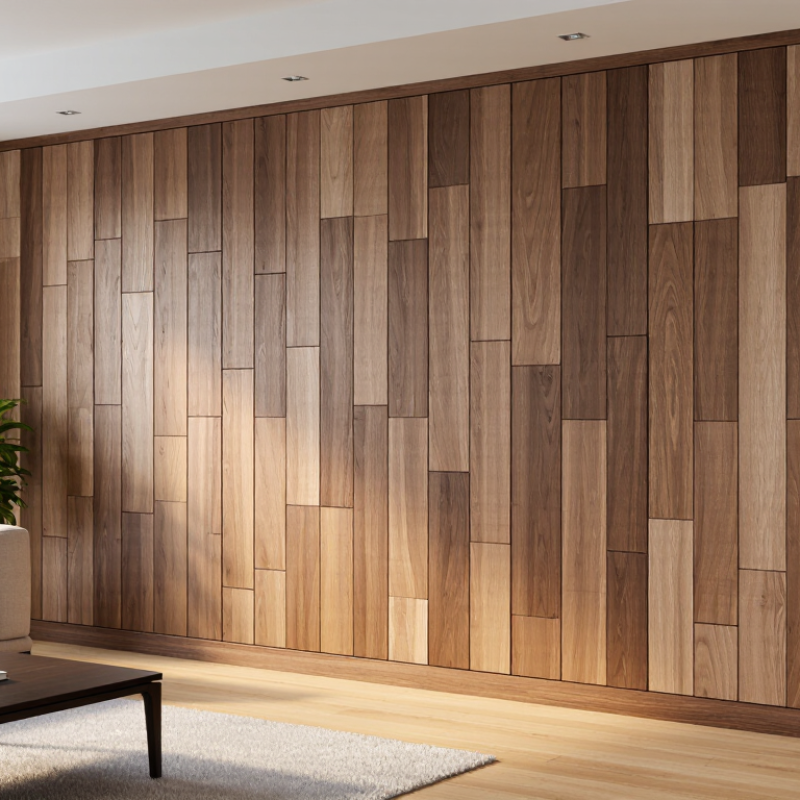
Faux wood wall panels are manufactured surfaces designed to suggest timber’s grain, knots, and color variation without using a solid wood face. Their cores may be made from PVC, polyurethane, MDF, or other composite materials. The choice affects weight, flexibility, and how the panel responds to moisture. It varies. Some panels are molded or pressed with a woodgrain texture; others are extruded, then embossed with rollers. Color may come from pigments, a printed film, or a coating applied over the surface.
The process depends on the material. MDF panels are formed from wood fibers and resin, then often covered with a decorative layer. Plastic profiles are heated and shaped, with texture added during or after extrusion. Polyurethane panels may be cast in textured molds. Not real timber. Compare several panels side by side: repeated knots or identical grain marks can make a wall look artificial at close range. Check the cut edge, backing, and installation instructions, not just the front finish. A realistic surface can still vary in durability, so confirm product details for the room where it will be used.
| Panel type | What it is and how it is made | Wood-look finish | Moisture and care | Often a good fit for |
|---|---|---|---|---|
| PVC / vinyl | Thermoplastic material is heated and extruded into panel profiles. Some products are solid; others have hollow chambers. Printed film or a textured surface supplies the wood effect. | Can reproduce grain patterns and colors consistently; surface texture and print quality vary by product. | The plastic itself is generally water-resistant, but joints, edges, and the wall behind it still need suitable detailing. Clean according to the product instructions. | Rooms where easy wipe-down is useful, provided the panel is specifically approved for the location and installed as directed. |
| WPC (wood-plastic composite) | Wood fiber or flour is blended with a thermoplastic polymer and additives, then commonly extruded into boards or profiles. Formulations differ between products. | May use a printed or laminated surface, a textured cap layer, or color molded into the composite. | Often more moisture-tolerant than untreated wood, but not automatically waterproof. Check the stated use, edge treatment, and cleaning guidance. | Interior accent walls where a wood-like appearance and a composite construction are desired. |
| Finished MDF | MDF is made by bonding wood fibers with resin under heat and pressure. A decorative paper, film, or laminate is applied to create a wood pattern; panels may also be routed or profiled. | A broad range of printed grain patterns and uniform colors; the surface generally provides the visual wood effect rather than exposed wood grain. | Standard MDF can swell if it gets wet. Keep it dry unless the product is specifically rated for more humid conditions; protect cut edges as instructed. | Dry indoor spaces where a smooth, consistent finish and easy-to-coordinate pattern are priorities. |
| Molded polystyrene or polyurethane | Foam-based material is molded into relief patterns or panel shapes. A coating or printed finish is often used to provide the color and wood-like appearance. | Can create raised grain, grooves, and decorative relief; realism depends on the mold, coating, and finish quality. | Care and moisture tolerance vary by material and coating. Foam panels may be vulnerable to impact, heat, or incompatible solvents; follow installation guidance. | Lightweight decorative applications, subject to product-specific fire, heat, and location requirements. |
| Printed or laminated engineered panel | A decorative wood-grain layer is bonded to a manufactured core, which may be fiberboard, particleboard, or another panel substrate. The core and surface layer determine many performance characteristics. | Offers repeatable patterns and finishes. A printed imitation is distinct from a real-wood veneer, which uses a thin layer of actual wood. | Performance depends on the core, surface, seams, and edge sealing. Do not assume a decorative laminate makes the whole panel waterproof. | Interior walls where a consistent pattern and a conventional sheet-panel format are preferred. |
| Flexible faux-wood veneer film | A thin printed or embossed polymer film with a wood pattern is supplied as a flexible covering. It is applied to a properly prepared surface or compatible substrate rather than functioning as a rigid panel by itself. | Can wrap simple shapes and cover existing surfaces; it does not provide the depth or rigidity of a thick wall panel. | The film may resist surface splashes, but adhesive, substrate, seams, and installation conditions affect durability. Use only on surfaces allowed by the product instructions. | Small decorative updates or smooth, prepared surfaces where a thin covering is suitable. |
Note: “Faux wood” describes the appearance, not one standardized material. There is no universal best panel: compare the product’s substrate, finish, installation method, stated moisture and fire performance, and suitability for the intended room. Performance varies by product; check its technical documentation and local building requirements.