Contact Us
STATEN ISLAND FIBERAMA

Choosing the right carbon fiber tube starts with the job it must perform, not its glossy finish. Will it carry bending loads, resist twisting, support a camera rig, or fit inside a compact frame? Those details change the best diameter, wall thickness, fiber orientation, and resin system. Small details matter.
A useful paraphrase of composite-materials researcher Dr. Alan P. Mouritz’s engineering guidance is: match the composite design to its loads and service conditions, rather than choosing by appearance alone. This is a paraphrase, not a verbatim quotation. For a real selection, compare the manufacturer’s specifications for stiffness, strength, dimensions, and tolerances. Check whether the tube is pultruded or roll-wrapped; their fiber arrangements can behave differently under load. Also consider temperature, moisture, impact exposure, and how the ends will be joined. A tube that feels rigid in your hands may still bend more than expected in a long span. I would not treat “carbon fiber” as a complete specification. It is only the starting point.
This guide explains how to assess tube construction, size, and performance before ordering. It also covers practical trade-offs, including weight, cost, machining, and connection details. A small mismatch can matter. Measure the available space, define the load case, and ask for test data when the application has little room for guesswork. Product descriptions can be incomplete, so verify the details that affect your design.
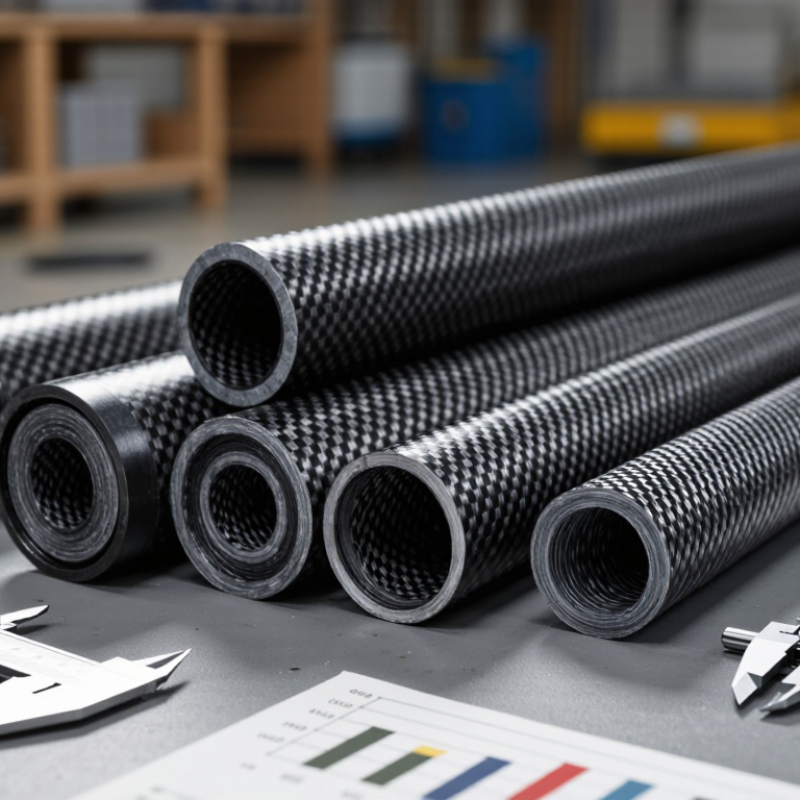
Before comparing carbon fiber tubes, define what the tube must do. Is it a camera boom, a brace, or a rotating shaft? Each application creates different demands. Record the peak load, unsupported length, allowable deflection, operating temperature, moisture exposure, and impact risk. Also specify how the tube connects to other parts; a strong laminate can still fail around a poorly designed clamp or drilled hole. A detail people miss. Write down the load direction, too. Carbon fiber is anisotropic, so strength and stiffness vary with fiber orientation.
Set measurable targets before choosing diameter or wall thickness. The U.S. Department of Energy’s lightweight-materials guidance reports typical carbon-fiber composite density around 1.5–1.6 g/cm³, compared with about 7.8 g/cm³ for steel. That weight advantage is useful, but it does not prove a tube will meet your stiffness or impact needs. Ask suppliers for laminate orientation, tolerances, and test data for the exact tube configuration. For bending, check deflection over the real support span; for compression, assess buckling, not just material strength. If the tube will see repeated loads, request fatigue data. “Strong enough” is vague. I would leave margin for uncertain loads and imperfect installation, then validate the selected tube with a representative test.
| Application | Primary performance requirements | Illustrative tube geometry | Laminate considerations | Checks before specifying |
|---|---|---|---|---|
| Lightweight equipment frame | Low mass, adequate bending stiffness, and resistance to local damage at clamps or joints. | Outside diameter: about 20–40 mm Wall thickness: about 1–2 mm | A balanced layup with fibers in axial and off-axis directions can support bending and handling loads. | Check maximum deflection, unsupported length, impact exposure, and how loads enter the tube. |
| Mast, boom, or long support pole | Bending stiffness, low deflection over a long span, and resistance to buckling under compression. | Outside diameter: about 30–80 mm Wall thickness: about 1.5–3 mm | Axial fibers contribute to stiffness; off-axis and hoop reinforcement can help resist splitting and local loads. | Evaluate span, end supports, wind or side loads, buckling, and any telescoping-fit requirements. |
| Rotating drive shaft | Torsional stiffness, fatigue resistance, low mass, and acceptable balance at operating speed. | Outside diameter: about 20–100 mm Wall thickness: about 1.5–4 mm | Off-axis fibers, often near ±45°, are important for carrying torsional loads; axial plies may also be needed. | Specify torque, speed, cyclic duty, critical speed, attachment design, and balance requirements. |
| Robotic arm or moving link | High stiffness-to-mass performance, controlled deflection, and durability around mounting points. | Outside diameter: about 15–50 mm Wall thickness: about 1–3 mm | A multi-directional layup may suit combined bending and torsion; local reinforcement can be needed at joints. | Check acceleration loads, vibration, fastener loads, bearing interfaces, and fatigue over the expected cycle life. |
| Air or fluid conveyance tube | Required pressure capacity, leak resistance, chemical compatibility, and reliable end connections. | Outside diameter: about 10–50 mm Wall thickness: about 1–2 mm | Hoop and axial reinforcement must match the pressure and end-load conditions; a liner or sealed inner surface may be required. | Do not assume a general-purpose structural tube is pressure-rated. Require design calculations, suitable fittings, and pressure testing. |
| Electrical support or insulating structure | Electrical isolation, mechanical strength, and performance in the intended moisture and temperature conditions. | Geometry depends on the support load; specify diameter and wall thickness from the mechanical design. | Carbon fiber is electrically conductive. Where electrical insulation is essential, consider a glass-fiber composite tube instead. | Confirm voltage, creepage and clearance needs, moisture exposure, and applicable electrical safety requirements. |
The dimensions shown are illustrative starting ranges, not design limits or certified ratings. Final tube selection depends on load cases, unsupported length, material layup, manufacturing method, joints, environment, and required safety factors.